
Koyo Pottery
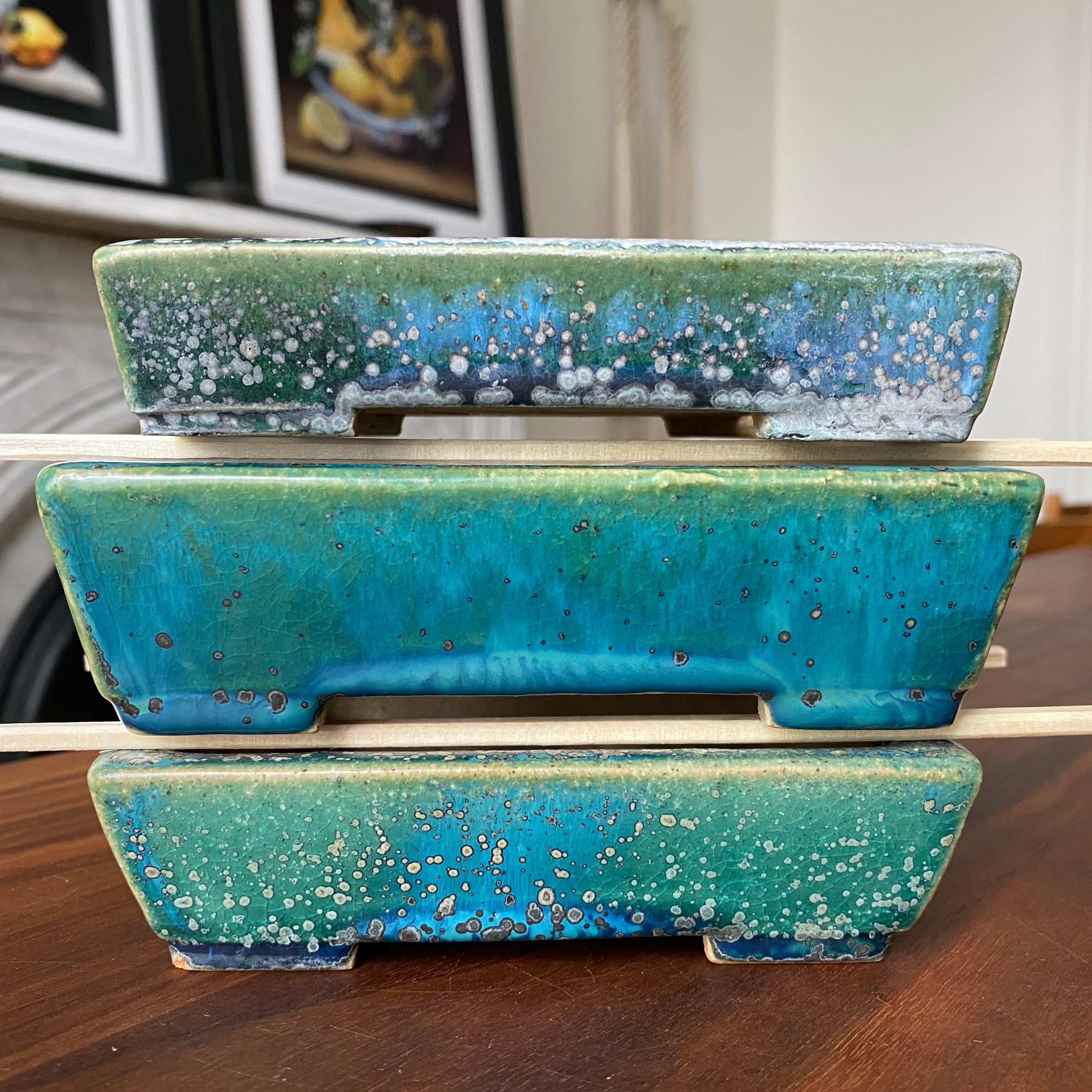
I have been collecting bonsai pottery for over a decade, with a particular interest in the work of the late Mr. Aiba Kouichirou (July 26, 1944 - December 23, 2021), of the Koyo kiln, which he founded in 1970.
A tentative relative chronology
At one point I had gathered several thousand examples of his oribe glaze, with the goal of detecting patterns in the outcomes of one of his most frequently used glazes.

I hoped that the different appearances of this glaze might correspond to changes in his methods or raw materials over time. My fantasy went further: if we could establish a sequence for his oribe glazes, could this then be mapped onto clay types and pot shapes to help us establish a relative chronology?
It turns out that this was not a very good idea, since Mr. Aiba Kouichirou always had multiple variations of oribe in use throughout his career!
What is in this blog post
Throughout this research I was able to gather information that I hope somebody someday might find useful. The following is a collection of images and information collected over a decade from various sources, including in-person visits to the kiln and communication with the family
What is not in this blog post
There are many other variables that come into play, which would make the blog intolerably long: pot shape, glazes, raw materials, techniques, clay type, pseudonyms, non-bonsai ceramics, stamps used by Juko (Aiba Kuniaki), etc.
Lets get started
Around the time when Mr. Aiba Kouichirou founded the Koyo kiln in 1970, and before he had any stamps, he used the following nail-carved signature.
All of the pots with this signature are remarkably heavy.
All of the pots with this signature are also all round ...

...with only one documented exception, an inexplicable oval:
This signature can be found on pots made from red clay (above), at time a when he was already working with several shades of red clay:
However, that early signature appears much more frequently on pots made from white clay with a fujisuna underglaze.
The signature itself appears in the two slightly different forms pictured above, and the 'broken up' form below.

Wait, what is fujisuna?
The black fujisuna underglaze is a powdered black lava from Mount Fuji used as a slip. We know that it was used from before the kiln opened, to about the 1980’s.
In this example below, no glaze was applied on top of the fujisuna -- everything you see is fujisuna!
The evidence for Koyo’s most recent use of fujisuna that I was able to find was a pot created for the 10th anniversary of the Ichikawa branch of the Japan Satsuki Association, in 1983, which aligns with the approximate dates that Mr. Aiba Kouichirou remembered he had stopped using fujisuna.

Pots without the fujisuna underglaze were also produced during this period.
So what? Are these dates useful?
Yes! Here is an example:
Mr. Aiba Kouichirou confirmed that the stamp below did not enter use until the 1980’s.

Therefore pots with both the fujisuna underglaze and this stamp--as in the image below--can safely be dated to the first half of the 1980’s, since the use of fujisuna stopped around 1983.

The stamp above is not to be confused with the stamp below, which Mr. Aiba Kouichirou confirmed was only used in the 1970’s and no later.
Let's talk Fuyo-En and Mr. Takeyama
The stamp below is used on pots commissioned by Mr. Takeyama of Fuyo-en nursery. It represents Mt. Fuji. The use of this stamp--an incredible collaboration--spans Mr. Aiba Kouichirou's entire career at the Koyo kiln, from 1970 until his passing in 2021.
In other words, if today (2026) you hold in your hands a Koyo pot with this stamp, that pot could be 5 years old (2021) or 55 years old (1970).
That's a huge time range - can we get more precise?
Yes! If that Fuyo-en pot you're holding has a fujisuna underglaze you now know that it was made from 1970 to 1983. That already narrows things down considerably!

...and if you happened to notice that lower stamp in the image above, then you now know that your Fuyo-en pot was made in the 1970's.

...and that's true, even if it doesn't have the fujisuna underglaze.
Below is the main kiln stamp
This is the most pervasive stamp, with no special significance other than noting that the pot was made at the Koyo kiln.
It is different from the stamp below, which signifies that the pot was 'hand made'. I use scare quotes here because there are differences in opinion about what hand made means depending who you ask around Tokoname or across the industry.

This stamp was used from 1970 until Mr. Aiba Kouichirou's passing, so it doesn't offer any particular insight in terms of dating ceramics.
Getting back to those Fuyo-en pots: many have the main kiln stamp as in the picture below
There are two others stamps that will help you know whether you're holding a 'special' pot from the Koyo x Fuyo-en collaboration.
One of those is the maple leaf stamp seen below, which was specifically used for custom requests from Mr. Takeyama, as opposed to the vast majority of pots commissioned by Fuyo-en which were mass produced in large batches.

The other is the gingko leaf stamp, which occurs almost always in conjunction with the main kiln stamp when it appears on Fuyo-en pots:
While the maple leaf stamp and the ginkgo stamp both signify that the pot was 'hand made', the maple leaf stamp was used exclusively on pots for Fuyo-en whereas the ginkgo stamp was used on any hand made pot (including those for Fuyo-en).
Some lesser known stamps
The oval:
and the round:
both of which are used for small pots, from 1970 to today
Speaking of small pots
Here is the main stamp for small size pots:
Above: Aiba Kouichirou
Below: Aiba Kuniaki
It sometimes occurs with the nail-carved signature:
and also in this less common form, sometimes wrongly believed to be a 'fake' Koyo pot:
On the topic of that nail carved signature, the most common is the 3-symbol:

but it also occurs in 2-symbol format:

and can appear on the outside of the walls of the pot, too:
or even inside the pot

Three weird ones
Before I let you get back to more important things, here are a signature and two stamps used by Mr Aiba Kouichirou that you've probably never seen before. They were used very early and very rarely.


It was confirmed by Mr. Aiba Koichirou that the pot below was his own work, but he did not have any comment to offer on the 'X' or the symbol above it.

Other stamps
Finally, below are some stamps that you might come across on Koyo ceramics, which point to less common collaborations, and special occasions:

The upper stamp in the above image was used for pots commissions by Koju-en
This column-shape stamp (on the right) was used for the Motobu Bonsai Association, Okinawa
This stamps used for Soseki-en, a suiseki dealer
These two stamps were used on a single firing of suiban, but I could not track down the name of the person who commissioned these ceramics.
This stamp was used for pots commissioned by the Tokoname yuyaku
These 2 symbols above the stamp represent a collaboration with the Omiya Bonsai Museum.
The upper stamp is from the Shutsuran Guild in Omiya
This triangle was used on a single firing in the 1970's, for an unknown buyer
Nippon Bonsai Association Okinawa Branch 10th Anniversary

The lower stamp in the above image has been untraceable

as has this one above. Anybody have any clues?


Finally these 3 last images are of pots made for the 50th Anniversary of the Nippon Bonsai Association. It looks like a lot of effort went into those 2 stamps, and I wish I had a better picture of them!
Wait, why doe the Fuyo-en / Mt. Fuji stamp appear on Nippon Bonsai Association pots?

,%20of%20the%20Koyo%20kiln,%20which%20he%20found...)